

On the Emerson Elementary School picket-line, during the strike of Spring 2022, we had educators who had witnessed first-hand, social movements in other countries, who had a different notion of the importance of striking, the importance of labor movements, the importance of taking a stand. What we were fighting for was so much bigger than Minneapolis. We need to hold oppressive systems of power, of capitalism and white supremacy accountable. It’s not just solidarity in the labor movement, it’s about cross-racial and cross-class solidarity.
— Rachel Schmitt
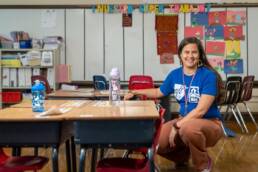
Roots in Education, Community, and Labor Activism
There were union organizers, teachers, and social activists in my mother’s family, though they may not identify themselves that way. My mom and her siblings grew up watching their dad working and organizing. When my uncle heard I was on strike, he told me, Your grandfather would have been so proud of you. He was a factory worker for Alcoa, a blue-collar guy who believed in his union. My aunt was a schoolteacher. My grandmother—who lived in Evansville, Indiana, on the Kentucky border, (which is technically Midwest, but it feels like the South)—did straightforward community organizing. When they were desegregating schools, she got a bunch of women in the neighborhood to do a carpool so that Black kids, who only had busses for the regular school day, could participate in after-school activities. I lost that grandma on my mom’s side when I was sixteen, so I wasn’t close to her when I was developing my social conscience, but I feel like I am continuing the legacy of my maternal grandparents.
My dad’s side of the family is from outside of Madison, Wisconsin, around Sun Prairie. His mother taught in a one-room schoolhouse. She got her teaching degree in her 40s after all her kids had been through school. She taught 6th grade for many years, in a Catholic school where my dad went, until she retired early because of a brain tumor.
Growing up with Education Values in Victoria, Minnesota
I grew up in Victoria, Minnesota, on the border of Chaska. My parents were moderate conservatives. They instilled in me the value of education. My Dad went to Northwestern University in Evanston on a football scholarship. Mom paid for her own college education, working full time to get her degree at Ball State University.
As a child I loved school. I dressed up as my second-grade teacher for Halloween. That year I found out how much money Kevin Garnett made and wrote a paper saying I think teachers should make as much as Kevin Garnett. I loved my teachers so much. I had a Black teacher for 7th grade:Mr. Finney. I know from my own experience that hiring and retaining teachers of color is important for white students like myself, and even more so for students of color.
Gustavus Adolphus College
When I first graduated from high school, I told everybody I wanted to be a journalist. I loved the idea of learning people’s stories. I went to Gustavus, the college that offered me the most financial aid. I had to retake calculus there and began to tutor friends in the course. That was the first time I saw that learning can be a communal thing. College wasn’t a radicalizing experience for me, but it got me questioning. I met some great people—teachers, and students—who planted seeds of consciousness. I still have all the abstracts I wrote for Professor Alisa Rosenthal’s Political Science course: Sex Power and Politics, reflecting on my belief systems and reactions to readings. My Spanish professors were great, and the language was easy for me.
I was required to study abroad for my Spanish major; I wanted to go to Latin America. As the oldest child, my parents had misconceptions about safety and how much they should intervene. As it turned out, I am grateful they convinced me to go to southern region of Spain. The Spanish was challenging, and my homestay taught me a lot about myself. Southern Spain was familiar to me in a way that was fascinating: it reminded me of Southern Indiana: the same warmth—literally and figuratively.
Teaching Adult Education in Spain
After college, I lived in Spain and taught English for a year. My student-teaching experience there was invaluable. Colleagues took me under their wing, providing a communal learning atmosphere and mutual support. I was hired as a language assistant, a position similar to paraprofessional in Minnesota. When I got there, however, they told me they were making me a “Lecturer.” I taught five levels of English. It was a school for adults, and I was often the youngest one in the room. There was such a wealth of knowledge around me. I learned about making lessons fun. My own language education had been focused on grammar, writing papers, reflecting on texts; there hadn’t been as much emphasis on communicating and building relationships with students.
In my advanced class, I used an article by Jose Antonio Vargas, exploring his experience living undocumented in the United States. That class discussion was rich; immigration is as contentious an issue in Europe as it is in the United States. Living in Spain—trying to blend in and not stand out so much, but feeling like I was always standing out—helped me relate to people who were newcomers to Minnesota, trying to adapt. I also understood that my experience was vastly different, steeped in economic and racial privileges.
The Struggle Against Education Austerity in Spain
Through that job, I got a window into the working condition of teachers in Spain. I taught a required class for teachers. They had more experience and knowledge of education than me. I went to my first protest for education reform while I was working in Spain. I wasn’t supposed to—because the government was paying me—but I went anyway because my colleagues were all going. Spain was implementing austerity measures, including massive education cuts. They ended up eliminating my position the following year. This was the beginning of my consciousness raising. In Spain and the United States, we have money to go to war, so why isn’t there money to pay teachers?
Is Communal Love Possible in the U.S. Education System?
As a teacher in Spain I experienced a sense of love. but my perception was that there was no room for that in U.S. public education spaces; there was too much stress and too little support for there to be love. I came back and worked a couple cafe jobs. I did an after-school program teaching Spanish in Shakopee and Hopkins to 6th graders and kindergarteners/1st graders. There was an openness in that program that I enjoyed. Often, I’d scratch half my lesson and add more play. I learned who my teacher-self was—improvising, being goofy with kids—but I didn’t think I could do that kind of teaching in a regular K-12 school day, when doors are locked and there is that sense that you’re shut in a school like a prison. We talk about a school-to-prison pipeline, but at times I think kids experience prison conditions while still in school. The architecture is similar, and when kids act up—when they have big feelings— they are seen as a problem child. There is often no room for big feelings in our schools.
Teaching GED
I landed a job in Columbia Heights, assisting in a GED program. My role was supposed to be “literacy assistant.” The teacher I was to assist left after two weeks. From then on, we went through a series of long-term subs. I was the consistency in the room. Pat Johnson, a retired Anoka-Hennepin teacher, was one of the subs. From her I learned about being patient, loving and kind in the classroom. Every day was different. There was no consistency whatsoever, which was a cool challenge. I was around adults. They all had busy complicated lives. The fact that they were making their education a priority was something to be celebrated.
I always thought my role in that classroom was to be a cheerleader. GED tests are so difficult, even for someone with a bachelor’s degree. They had trick questions. I wasn’t historically a good test taker. I was somebody who succeeded through classroom discussion, papers, and homework assignments. I live with anxiety. Here I was teaching folks how to take a test. I noticed that our materials weren’t always helping them with skills they needed for the test, and I did what I could to make sure they passed it.
The job was full of hardship and hope. I saw how those two things can coexist. My classes had a mix of native English speakers and non-native English speakers. I had a Syrian man who spoke four languages. Sometimes students had left school in other countries and were working to get their English to the level where they could take the test. Oftentimes the education they obtained in other parts of the world wasn’t seen as valid. That’s rooted in racism and xenophobia—the colonizer mentality. The GED students had so much lived experience, so much intelligence, it often felt messed up that I was the one in the room doing the teaching.
I thought I might want to be a GED teacher full time. I started subbing at Neighborhood House in St. Paul, and in Columbia Heights. I became a favorite sub over at the Wellstone Center and was asked to apply for a job. It was a .8 position as an English teacher. It’s hard to get a 1.0 position in Adult Education.
Teaching English at the Neighborhood House
I worked at the Neighborhood House for three years, teaching two levels of English. The beginning literacy class was so much fun. I’m passionate about the beginning levels of reading and writing, which is why I love working with kindergarten and 1st graders now. That entry level space where people are like, “we’re going to take this on and do the best we can,” has the same feeling with young children and elders. Being that person to help facilitate their journey is an honor. Sometimes I would have people from four continents in one class. They were my teachers. It got to be overwhelming how thankful they were for the English classes. I was happy to be helping these people feel like they could participate in day-to-day life in Minnesota, but I was also aware English is a colonizer language, the language of business, of capitalism. I started realizing how messed up it is that they needed English so badly. I wish more people in the U.S. spoke their languages.
Racist Assumptions in Social Services and Data Collection
Sometimes the forms people were required to fill out—by United Way to take an English language course, or receive other assistance—were invasive. I remember one student from Cuba saying, “I’m here to learn English, not fill out forms with personal information, about my income, my ethnicity, race or gender identity.” A professor called it “data rape.” I know that is strong language, but I saw that in the GED program, where Black and Brown people were being asked questions that the teacher—and program—had no real need to know.
I was a research assistant at the Minnesota Humanities Center in 2017. They trained educators in some core values. One of them was to recognize the power of story and the danger of absence. Around that same time I also heard Chimamanda Ngozi Adichie’s TED Talk, “The Danger of a Single Story.” It is so easy to assume a single story from people who come to Minnesota from far away. Along with that assumption is the idea that as the educator you know what they need. But I believe that solutions reside in community: another one of the core values taught at the MN Humanities Center.
Teaching English Through Lyndale Neighborhood Association
I left Neighborhood House in 2016, and started taking classes at the U of MN, towards what I thought would either be in a Master’s in Adult Education or Program Evaluation. My adviser pushed me and supported me in that direction, and she was convinced I needed to get my PhD. I wasn’t sure, but I did complete all the credits for the MA program. During graduate school I worked at the Lyndale Neighborhood Association. I enjoyed working alongside people who were passionate about social change and social justice: disrupting the status quo and making life easier for newcomers in the community. One of those people was Adriana Cerrillo.
I taught night classes in beginning to intermediate English, in a church basement and the main floor of Horn Towers — the apartment complex south of Blaisdell. My students were Somali elders. I learned so much from them and I still miss seeing them every week. At Lyndale, I saw more evidence of the non-profit industrial complex and how data is used against people rather for and with them. Ultimately, it gets into the hands of somebody who has more power and privilege. If the decisions you’re making using numbers, or even stories, aren’t directly impacting the lives in positive ways for the people included in the data, then you are just aiding capitalism. Thinking you have the right to mine that data, is a white settler colonial mindset.
Becoming an Activist
During my time in Adult Education, I became more aware of what it meant to be an activist, an advocate, an ally, an organizer. I know all those things are different. I was awakened partially because, at the time, I was in an interracial relationship. The public lynchings of Jamar Clark and Philando Castile made me a more active protester. I went to a training put on by the IWW, with the intent of helping organize a union across non-profit adult Ed programs. I learned that something like that is a longer-term project.
There is a limit to our ability to predict the right time to organize or the timeline for social change. In 2020, after the murder of George Floyd, I saw people—who had stayed on the sidelines when Jamar Clark was murdered—show up and come out.
Returning to the Classroom as a Spanish Immersion ESP
After working in Adult Ed, I left teaching for a bit, and worked at Butter Bakery and Café. I was making mental health my focus, trying to get some clarity of purpose. I was wrapping up my graduate classes, and still had my thesis to finish, when I realized I missed the classroom. I didn’t know what kind of classroom I would return to, but I missed being around students. I wanted it to be more about people than data, research, and evaluation. I didn’t want a life in front of the keyboard. That is when family intervened.
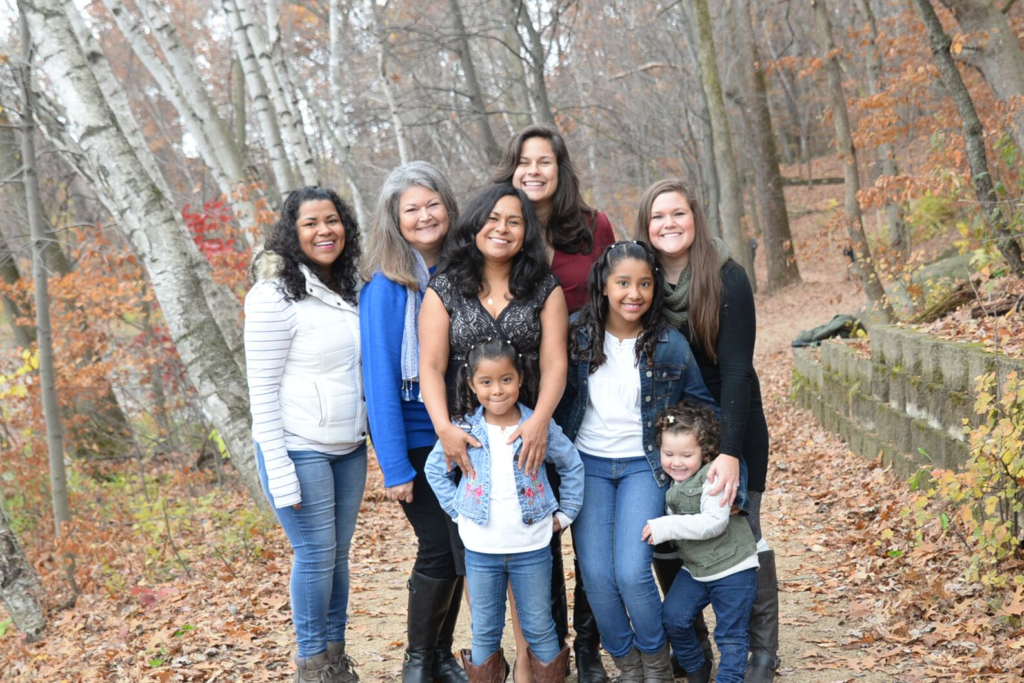
My sister and her husband met when he was a cook, and she was a server at a restaurant. He came to Minnesota from Morelos, Mexico. He has two sisters in Minnesota who have become my bonus sisters. I became Tía Rachel, involved in the day-to-day lives of my nieces and nephews. My bonus sister Loli saw how I worked with her kids and said, “You have a gift. You need to be a teacher.”
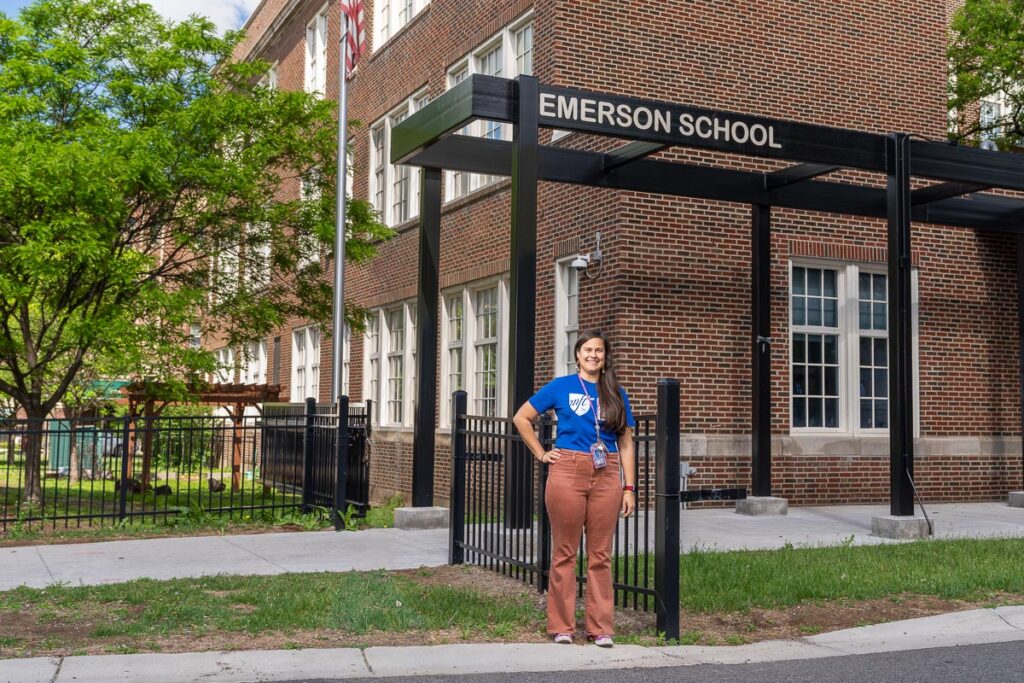
I was still not sure I had the patience needed to deal with the structural stuff in schools. But I never felt like I was making enough money working in nonprofits. I had good benefits, but the pay wasn’t great. Teaching would provide a better wage. Loli was working as a paraprofessional in the Eden Prairie school district in their bilingual immersion schools. She knew a similar place would be good for me. I applied to Emerson Spanish Immersion Elementary School, in Loring Park, in the spring of 2019. My interview was Wednesday, I was hired on Friday and started work on the next Tuesday. I quickly learned that there was a shortage of folks in Minneapolis who have a bachelor’s degree, are bilingual, and were willing to get paid the amount that an ESP is paid. I have been working at Emerson ever since. There is room for love at Emerson.
When the pandemic hit, my job completely shifted. I learned how to be a tech support person. I was blown away by the acrobatics that my colleagues went through on a day-to-day basis during the period of distance learning. Expectations for everyone were still very high and there wasn’t room for processing what was going on, both with the pandemic and the uprising following the murder of George Floyd. We could see the opportunity gaps in starker relief.
The 2022 Teacher’s Strike
The narrative during the strike was, “we have a priority crisis not a budget crisis.” I struggled with the counter-narrative that the teachers were being greedy. It’s classic union-busting stuff. We needed more mental health supports in schools. We needed kids to see themselves reflected in their teachers. We needed to talk about racial injustice and police brutality.
Why aren’t we talking about abolition more openly in the schools? I know it’s a consciousness-raising piece. We must be comfortable having conversations about what is safety and what is harm. These are difficult, personal topics that directly impact students. There are so many different intersections of struggle. If we were to treat those intersections as important—if we were to meet students where they’re at—that would be a game changer. To do that, at the very minimum we need smaller class sizes and mental health supports.
The fact that we have educators leaving the district in droves also has to do with the comprehensive district design that came out in the middle of a pandemic, shuffling around kids and teachers. We had a superintendent who saw schools as businesses rather than as places where kids are educated. He would rather hide or bully us than face the issues we were fighting for. The school board was divided, too. They gave the superintendent a vote of confidence prior to his decision to leave. It was a close vote, but it still passed.
I grew up in Minnetonka schools and with nannied kids in Edina. I know how completely different school is for suburban kids versus the kids I now get to see every day. It’s outrageous, maddening, and disheartening. The way the education system is designed doesn’t often allow for questioning. I feel grateful for my organizing mentor and friend Sam Crossley, and for organizing spaces like the Social Justice Education Movement to come together around these issues.
The district is made up of a majority of BIPOC students, yet school staff are disproportionately white. The difficulties that all families faced because of the strike were real, but it was even scarier to think of us going back to the way things were. Part of why we were on strike was because we wanted more mental health support. There were 555 kids at Emerson this year and we have just one social worker on staff and one part-time psychologist. That’s ridiculous. We were also fighting for smaller class sizes. They capped my class sizes at 22 or 24 when I was an Adult Education, but I had colleagues with 32 students this past year. The fact that most of the ESPs—who are more likely to be teachers of color—have to have additional jobs, is so wrong.
On the Picket Line at Emerson
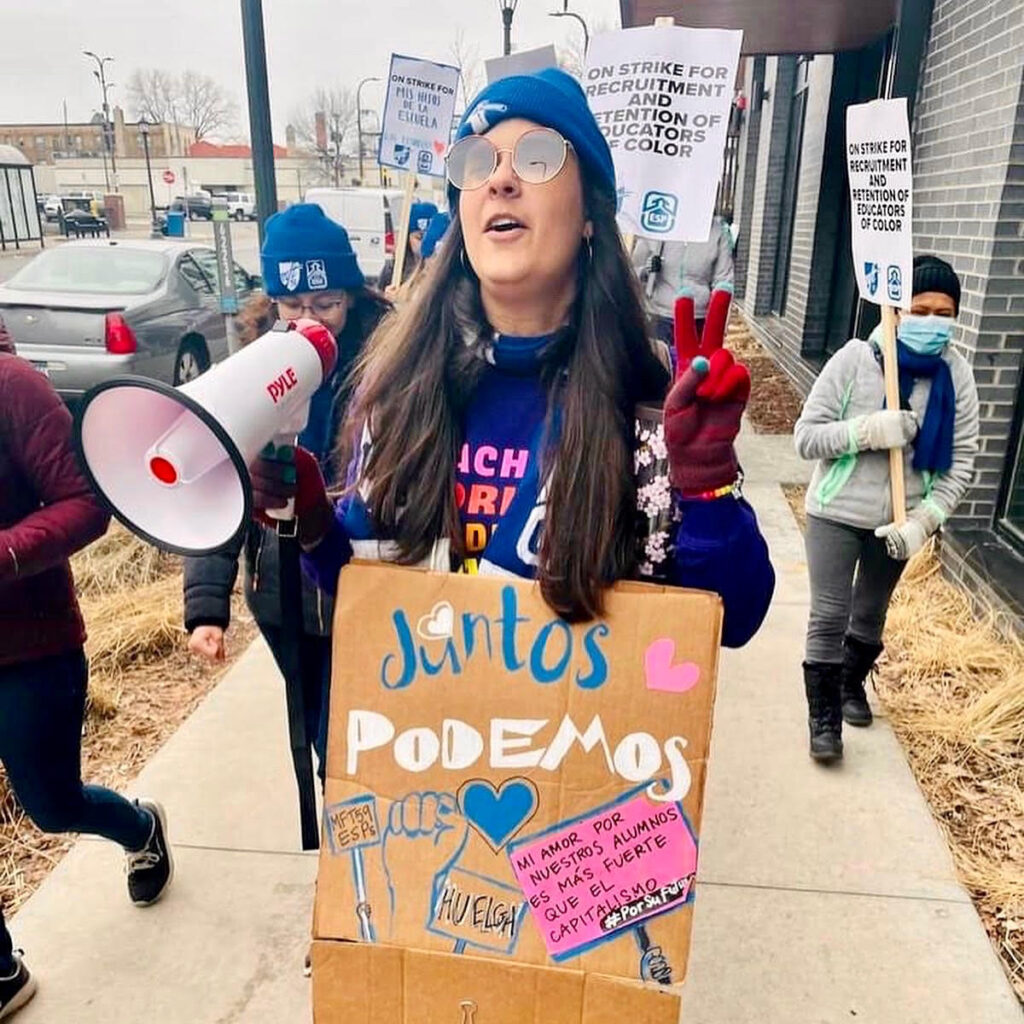
It was so cold on the picket line, but we found room for love and protest. We were out there on the line, freezing and at the same time we were dancing, laughing, and having wonderful conversations. Joy is an act of resistance. Students showed up. Once, I was leading a chant, and two of my students came over and began to lead a chant: But what about the kids? EXACTLY!
I feel honored to be at Emerson and, at the same time, it’s hard work. There were some days this past year, that felt like a nightmare, where I made eye contact with another staff person and we were both like, how is this the reality right now? The kids aren’t all right. They need more from us and we’re not able to give them more because we don’t have the capacity. Our classes are too big. We need people who are trained and mental health professionals helping kids handle trauma.
There was so much trauma before the pandemic. Now it’s only intensified. We forgot how to be around each other—kids and adults. Most of the discussion is about the pandemic and schools is about academic achievement—the kids are behind! It makes me sick. We’re not addressing their basic needs, their social and emotional needs, their hearts, their big feelings, other than to tell them to take a break, shut up and keep quiet. We all need to be honoring those big feelings, moving through them, allowing ourselves to be not OK.
On the Emerson picket line we had educators who had witnessed first-hand social movements in other countries, who had a different notion of the importance of striking, the importance of labor movements, the importance of taking a stand. I truly admire my colleagues. What we were fighting for was so much bigger than Minneapolis. We need to hold oppressive systems of power, of capitalism and white supremacy accountable. It’s not just solidarity in the labor movement, it’s about cross-racial and cross-class solidarity.
Becoming a Teacher; Advocating for Equity Among Educators
I finally listened to my gut—thanks to the seed Loli planted—and I’m attending Hamline to get my K-12 master’s in teaching ESL. Back in April, my Tier 2 license was approved, and I joined the English-Language team at Emerson. I got to teach English to the same first graders I worked with as an ESP.
ESPs make so much less money than licensed teachers. My colleagues who prefer to stay working as ESPs should make a living wage. The strike increased wages in a significant way for ESPs, but more work needs to be done. Support staff are vital. They make school happen. At Emerson there are times you don’t feel the hierarchy. Everyone is Maestra/o. Our wages need to reflect that equality.
After the Strike
Indicative of the district’s lack of respect is how we were treated after the strike. The district added two weeks to the calendar and 42 minutes to the school day. It was tough to see students, especially younger ones, struggle with the extended day. Two months after strike was over there was still a lot of unresolved tension around the budget and the future of MPS.
Towards the end of the school year, I struggled with my role at Emerson. In June, I went through the emotional rollercoaster ride of Interview and Select, not knowing whether I’d have a job next year. I felt depleted. I didn’t have the capacity to get more involved in organizing, nor engage in the important conversation Emerson was having around school uniforms, an issue that divides our community nearly 50-50 (56% voted in favor, 44% against). I feel frustrated by that. I wonder, to what extent will uniforms exacerbate problems we already are seeing in school next year at Emerson? Is it possible to make space for organizing while feeling uprooted and devalued?
Following the strike, I’ve been thinking about the very real exhaustion and burn out that educators feel, especially educators of color, in the current system. How can I keep saying my heart is still in it, knowing that colleagues I trust and respect, are either leaving or considering leaving MPS and/or teaching altogether? In what ways am I perpetuating whiteness in my teaching and organizing? To what extent am I romanticizing what was going on during the strike because of my positionality? How do we keep challenging the scarcity, deficit narratives in education? How do we make space for both self and communal care in a system so heavy?
Final Thoughts
The system was designed for kids like me to enjoy—a “good education” rooted in whiteness and erasure. I’ve been reflecting on the emotional and intellectual labor offered by family, friends, friends-who-have-become-family, educators, academics, students, and neighbors who don’t experience the world with the same privileges I do, to help me start my lifelong journey of unlearning, relearning, and developing a more critical consciousness. It’s a heavy, ugly, real thing. I would not be at this place without them. And that’s so messed up.
My life is not linear. My journey is a zigzag. I had a very protective childhood, rooted in whiteness. In learning a new language, I saw how being outside of my comfort zone is where growth and beauty exists. You can learn from someone when you are able to speak their language, and they are able to learn from you too. Communal learning.
When I was in school for Evaluation studies, I took a course with Dr. Nina Asher called “Post-colonialism and Globalization in Education,” where we reflected on the fact that we have multiplicities in each of us. We must reimagine schools, so they are welcoming and safe for those multiplicities. In that class we discussed Pedagogy of the Oppressed, read bell hooks, Franz Fanon, Gloria Anzaldúa, Marjane Martrapi, and Trinh T. Minh-ha. I remember thinking to myself: finally!
I am grateful for the opportunity to struggle, critique, and return to the question, what it would mean to be overtly anti-colonial, anti-capitalist or anti-racist: to not hide behind whiteness in education? A book I read in 2013 by writer, lawyer, and activist Deepa Iyer, called We Too Sing America focused on post-9/11 immigration policy toward Muslims and Sikhs in the U.S. She has a podcast called Solidarity is This. I started listening to it in 2017. That is when I started thinking about solidarity as a practice; fighting for what’s right, even if it doesn’t always affect me personally.
But I have changed my mind about that recently. It does affect me. My liberation is tied up with everyone else’s.
Since I lost a friend to suicide in 2021, I changed the way I talk to and about my students. I am more forward about using the word “love.” There are all kinds of love. What I know is how we love, who we love, why we love is a part of the answer. We need to build stronger relationships and stand up for each other. It’s about not waiting until it affects us directly— our neighborhood, our family, our school. Solidarity is about communal love.